This article is part of our Back Pain series at Warwick Chiropractic & Massage in Lacey, WA. For the complete overview, see the full guide:
Yes—we use traction-based approaches for disc problems, and the right choice depends on the individual and what we find during your visit. When people ask about chiropractic traction vs spinal decompression, we explain that both are forms of traction, but they’re delivered differently and used with different goals in mind. In our office, we commonly use a Leander lumbar flexion distraction table, and we also combine traction approaches with chiropractic adjustment when it’s appropriate.
What do we mean by chiropractic traction vs spinal decompression?
In everyday conversation, people often use “traction” and “spinal decompression” as if they’re the same thing. Clinically, we think of them as related categories.
- Traction is a broad term for gently creating distraction through the spine.
- Spinal decompression is also a traction approach, typically delivered through a specialized table with straps or bracing connected to a pulley system.
So when we talk about chiropractic traction vs spinal decompression, we’re really comparing two different ways to apply traction—one being our flexion distraction table approach, and the other being decompression-style systems that can be used in chiropractic or physical therapy settings.
What traction for a disc problem do we offer at Warwick Chiropractic & Massage?
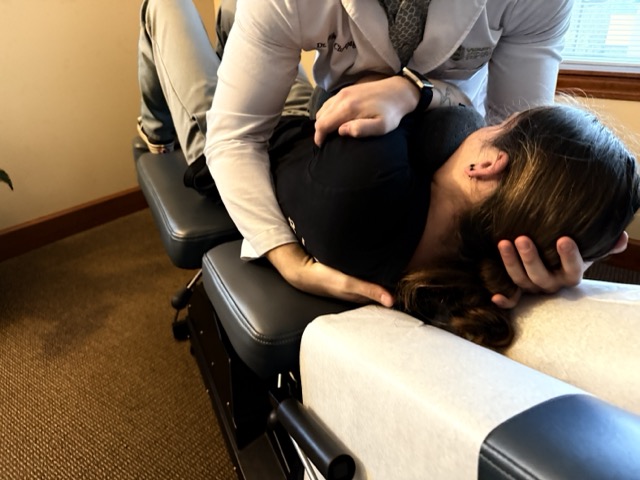
At Warwick Chiropractic & Massage in Lacey, Washington, one of the main tools we use is a Leander lumbar flexion distraction table. This table is designed to create a gentle distraction to the lower back, and we use it with people who present with issues such as:
- Disc issues
- Lower back pain
- Scoliosis
- Various types of curvatures
The table moves almost like a fulcrum, and we can change the height and the speed (including variance of the speed). It also allows lateral movement—bending to the side while the motion is occurring—at a variable speed.
It’s a motorized type of traction, and we can also add hands-on elements during distraction. In some setups, the patient may be strapped in or may hold the front end of the table to obtain a bit more distraction or traction.
What parts of the spine does the flexion distraction table affect?
With the Leander flexion distraction table, we’re applying distraction to the lower back and affecting the vertebrae—such as the posterior disc section, the lateral portion, or a combination of those areas.
Most commonly, patients in our office do receive this treatment. Not every patient receives it, but a vast majority do, because we often start on a lower, minimal setting.
Can traction be applied beyond the low back?
Yes. One reason we like this approach is that it can be a great way to traction the spine all the way up toward the cervical area. We can start in the lower back and work our way up throughout the spine, all the way up to the neck area.
How is spinal decompression different from traction?
Spinal decompression is another form of traction delivered using a specialized table. It commonly involves body devices—like straps or bracing—connected to a pulley system, with settings that take into consideration the area being decompressed. Sometimes what’s used is destabilization of the segment.
Many times, imaging is done when using decompression-style tables. The pull forces (including the poundage of pull forces), time duration, and frequency can be adjusted. The traction is often applied with a gradual increase to a peak amount, done sequentially over time—like about 20 minutes.
In the broader community, some chiropractors use decompression systems such as the DRX-9000. There are also systems from Chattanooga, and traction or decompression devices are used in some physical therapy offices as well.
Which is better: chiropractic traction vs spinal decompression for disc issues?
We don’t treat this as a one-size-fits-all decision. In our experience, traction for disc issues can be beneficial, and for us it has been beneficial for a torn disc in the lower back—but it is not a substitution for the adjustment. The biggest impact is often with the adjustment, especially when you combine both.
That’s why we combine therapies in our office when it makes sense for the person in front of us.
What does traction feel like, and how long does it take?
The amount varies, but on the flexion distraction table in our office it’s typically over eight minutes and not typically more than 15 minutes. We keep it low and slow: a low angle of traction and a slower rate of speed.
In terms of how it feels, many people describe noticing tight muscles—sometimes muscles they didn’t even realize were involved—when the light traction begins. As the motion starts, patients commonly report it feels like a gentle stretch of the muscles and soft tissue, and we use it in a way that also hydrates the disc.
Before we do any work, we apply an application of heat to warm the area and help get things moving, including circulation moving more.
What conditions do we commonly use traction for?
In our clinic, the flexion distraction table is a tool we use for cases such as:
- Lower back pain
- Chronic lower back pain
- Disc issues
- Bulging or herniated leg pain
- Scoliosis
This approach is helpful for most patients we select it for, and we decide based on what you present with and what we find during your evaluation.
When is traction not the right tool for a disc problem?
There are situations where traction is not the right tool. One example is when we suspect a really severe case of herniation or prolapse of the disc—where the disc is torn enough that it’s sequestered down the spinal canal or needs more immediate attention—especially when the patient cannot even lay down.
At that point, it becomes a matter of practitioner experience: knowing when to stop, when to seek other modalities, and when to involve other providers to help triage and calm things down.
When do we consider imaging or involving other providers?
We look at imaging and talk with patients on an individual, person-by-person basis to understand what’s going on and how we can better help. That may include discussing whether we should involve another doctor, a physiatrist, or a surgeon.
Some cases shouldn’t be managed in the office. One important red flag we take seriously is losing bowel or bladder control—at that point, we’re talking about surgical intervention.
What can we realistically promise with traction or decompression care?
We don’t think any medicine really promises anything. What we provide is an opportunity for hope and healing—so you can get pain relief and feel better with the work we do.
And if we aren’t successful with conservative treatment, we work to help get you in a direction that supports you, including:
- A better understanding of what you may have going on
- Clarity about what we’re discovering and how we can help you move forward
- Guidance on what you can do in the office and outside of the office
- Support in taking more responsibility for your health
We also believe in personalizing and customizing treatment to each individual and being transparent about what we can and cannot do. Traction is one tool we may use inside of a broader plan; by itself, it does not fix people’s pain all by itself.
Key Takeaways
- When comparing chiropractic traction vs spinal decompression, both are traction approaches, but they’re delivered differently and adjusted differently.
- In our office, a Leander lumbar flexion distraction table is commonly used as a gentle, motorized traction approach for the lower back.
- Flexion distraction sessions are typically over eight minutes and not typically more than 15 minutes in our clinic, using a low and slow approach.
- We consider traction helpful for many cases, but not appropriate when we suspect a severe herniation or prolapse, especially if a patient cannot lay down.
- Losing bowel or bladder control is a red flag that can point toward surgical intervention rather than office-based care.
Where to go from here
If you’re dealing with disc-related back pain and want a clear, individualized plan—not a one-size-fits-all approach—we’re here to help at Warwick Chiropractic & Massage. You can find us at 8650 Martin Way E Ste 207, Lacey, WA 98516, and our team includes three doctors so we can help new and returning patients get evaluated efficiently. Walk ins welcome or schedule an appointment online.
Frequently Asked Questions
Do you do spinal decompression for a disc problem?
Yes, we use traction-based approaches for disc problems, and spinal decompression is one form of traction. In our office we commonly use a Leander lumbar flexion distraction table, and we may combine traction approaches with chiropractic adjustment when appropriate for the individual.
What is the difference between chiropractic traction and spinal decompression?
Chiropractic traction is a broad term for gently creating distraction through the spine, while spinal decompression is typically delivered on a specialized table using straps or bracing connected to a pulley system. Decompression tables often allow changes in pull forces, duration, and frequency.
What traction equipment do you use in your office?
We use a Leander lumbar flexion distraction table, which creates a gentle distraction to the lower back. The table moves like a fulcrum, with adjustable height and speed, and it can also laterally bend while the motion occurs. Hands-on segment contact can add traction.
How long are you on the flexion distraction table, and what does it feel like?
In our office, time on the flexion distraction table is typically over eight minutes and not typically more than 15 minutes, using a low and slow approach. Many people describe feeling a light traction that stretches tight muscles and soft tissue, and we warm the area first with heat.
When is traction not the right tool for a disc issue?
Traction is not the right tool when we suspect a really severe herniation or prolapse where the disc may be sequestered down the spinal canal or needs immediate attention, especially if the patient cannot even lay down. In those cases, we consider other options and referrals.
What do you tell patients traction can realistically do, and what can’t you promise?
We don’t think any medicine really promises anything. What we provide is an opportunity for hope and healing so patients can get pain relief and feel better with the work we do, and if conservative care isn’t successful we help guide patients toward appropriate next steps.
Ready to feel better? Walk in today or book online – most new patients are seen within 24 hours.

Dr. David Warwick, DC, is a board-certified chiropractor with over 30 years of experience helping people find fast, effective relief from back and neck pain. He is the only chiropractor in Lacey, WA certified in the Zone Technique — a specialized healing method that restores balance to the body’s six systems for long-term wellness.
At Warwick Chiropractic & Massage, Dr. Warwick focuses on short-term, results-driven care, helping patients return to life without unnecessary long-term treatment plans. His clinic welcomes walk-ins and offers convenient online scheduling for modern, flexible chiropractic care.
Dr. Warwick is committed to educating his patients and the public about natural pain relief, spinal health, and how chiropractic care can be both simple and life-changing.
Originally spoken aloud by Dr David Warwick DC. Edited with AI assistance and reviewed before publication by Rich Hull.
The original recording this article was written from
Further Reading: Back Pain
- Short-Term Chiropractic Care & The Warwick Way
- Chiropractic and Massage Better Together?
- Walk-In vs Scheduled Appointment What’s the Difference?
- Does Insurance Usually Cover Chiropractic Care?
- Warwick Chiropractic vs Other Chiropractic Clinics in Lacey What Fast Access Really Means
→ Complete Guide: Back Pain Treatment in Lacey, WA — The Complete Guide